Spider-Man has spent decades swinging between buildings. This time, he swung past the Avengers.
Spider-Man: Brand New Day opened with US$360.1 million in ticket sales across the United States and Canada, according to final figures reported by AP and Box Office Mojo. That put it just ahead of the Avengers: Endgame opening at US$357 million in 2019, in nominal terms.
The opening is part of a global release cycle across major markets, with local cinemas adding momentum as the run continues.
The number is extraordinary. The useful question for a business owner is ordinary: what had to be true before that many customers decided to show up at once?
1. Use trust, or build it
This year, many titles in both superhero and general cinema have struggled despite polished trailers, paid promotion and social momentum—Supergirl and Superman were widely discussed as examples of this trend. So the question is not just why a launch works, but what made Spider-Man an outlier.
Chantelle from TAS highlights six practical lessons for businesses operating under a saturated market.
Spider-Man did not rely on one breakout film moment. It had four films behind it, so the audience already knew what to expect.
For new businesses, the first task is the same principle: trust must be built before a campaign can scale. Trust is not automatic, and teams often skip this because they are focused on selling.
- Put a Google review QR code where customers can quickly review after service;
- send follow-up emails asking for feedback once the work is delivered;
- request testimonials from long-term customers you already serve well;
- if they agree, ask happy customers for short customer clips they can share.
If you do not ask, you cannot grow proof at scale.
For a long-running business, the playbook is simple: refresh your look, product, pricing and messaging for today, but keep and amplify your relationship history. That is why Spider-Man could present a refreshed version as a Brand New Day instead of pretending to be a reboot.
For a start-up, this is the first step: build a system that captures customer experiences and helps you reconnect with them through targeted follow-up.
2. Polished marketing opens the door, trust closes the sale
AI can make almost anything look premium. Beautiful assets and smooth ads are useful, but they only open the door.
Your work then is to make the promise real every day. Ask:
- Can a customer explain the offer after a quick read?
- Can staff answer important questions consistently?
- Are prices, availability and lead times clear?
- Can a quote or invoice arrive without delay?
- Can the customer pay with minimal friction?
- Does follow-up happen without reminders?
Brand polish gets attention. Delivery quality gets the sale.
3. Preserve trust while refreshing the offer
When Spider-Man moved from old cycles to Brand New Day, it did not erase itself. It refreshed the packaging, then served the familiar promise more clearly.
For business, this means you can modernise without breaking recognition:
- keep core service standards consistent;
- avoid replacing what works in the customer experience;
- improve your operational execution where the old process was weakest.
This does not replace launch preparation. It prevents a fresh-looking launch from feeling unfamiliar to existing customers.
4. Build demand before launch day
The film’s first trailer reached more than 718 million views in its first day and was supported by early screening and pre-release activity. The lesson is sequencing, not scale.
- explain the customer problem before final announcement,
- offer a useful preview rather than every detail,
- brief staff and partners in the same version of the message,
- invite early users to controlled trials,
- collect real objections before full release.
The first public day should not be the only day people hear your story.
5. Prepare the operation for the promise
The film opened across 4,487 North American cinemas. Whatever the creative achievement, that opening also depended on distribution, schedules, staffing, screens and thousands of customer-facing hand-offs working at once.
This is where many business launches become less cinematic.
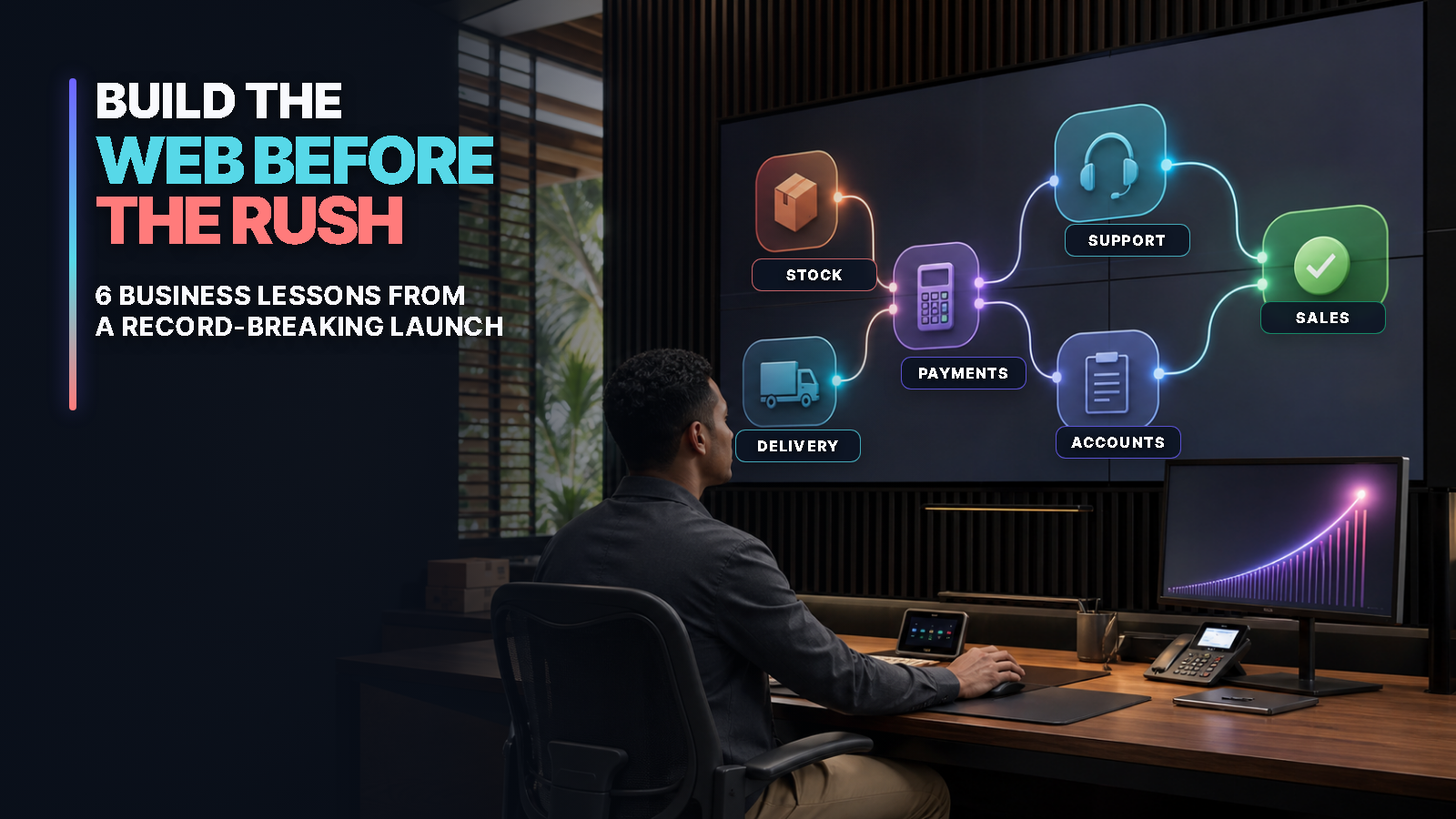
Before launch, walk one normal order and three awkward ones through the full operation:
- Where does the enquiry or order begin?
- Who confirms price, availability and delivery?
- What happens in the sales or point-of-sale system?
- How do stock and accounting records update?
- Who handles a cancellation, return, correction or failed payment?
- What does the customer receive, and when?
The best launch day is exciting for customers and controlled for the team behind it.
6. Make quality, not hype, the engine of repeat demand
A lot of launches spike and fade. Better launches survive beyond the first week.
For film this appears as repeat watching and strong audience sentiment. For a service or product business it appears as reorders, renewals, referrals and lower churn.
- What happens after the first sale?
- Does the service hold up under repeat use?
- Would a customer recommend it without being asked?
The Sunday estimate suggested a US$355 million opening—slightly below the old record. Final figures arrived higher, at just over US$360 million, after a stronger-than-expected Sunday.
That difference is a reminder for every management meeting: forecasts prepare, actuals prove.
A healthy launch operation links sales, quality and reconciliation.
- enquiries from confirmed orders;
- orders from delivered sales;
- invoices from cash received;
- gross sales from margin;
- expected stock from stock on hand; and
- marketing reach from qualified customers.
A six-point launch-readiness check
Before your next product, promotion or system change goes public, confirm:
- Promise: Customers can understand the value quickly.
- Trust: Testimonials, reviews or outcomes are current and accessible.
- Systems: Sales, inventory, payments and accounting share the right information.
- Operations: Demand, exceptions and support capacity have been tested.
- Numbers: Demand, completed sales, cash, margin and service issues are measurable from the same workflow.
- Loyalty: There is a repeat-and-referral plan beyond day one.
You may not need to serve the equivalent of 4,487 cinemas. But every meaningful launch creates the same obligation at its own scale.
Records are the result, not the strategy
It is tempting to look for one secret move. Usually, the visible number sits on top of trust, preparation and steady operations.
You do not need a cape. You need a clear promise, a launch runway, connected work and a product people want to experience again.