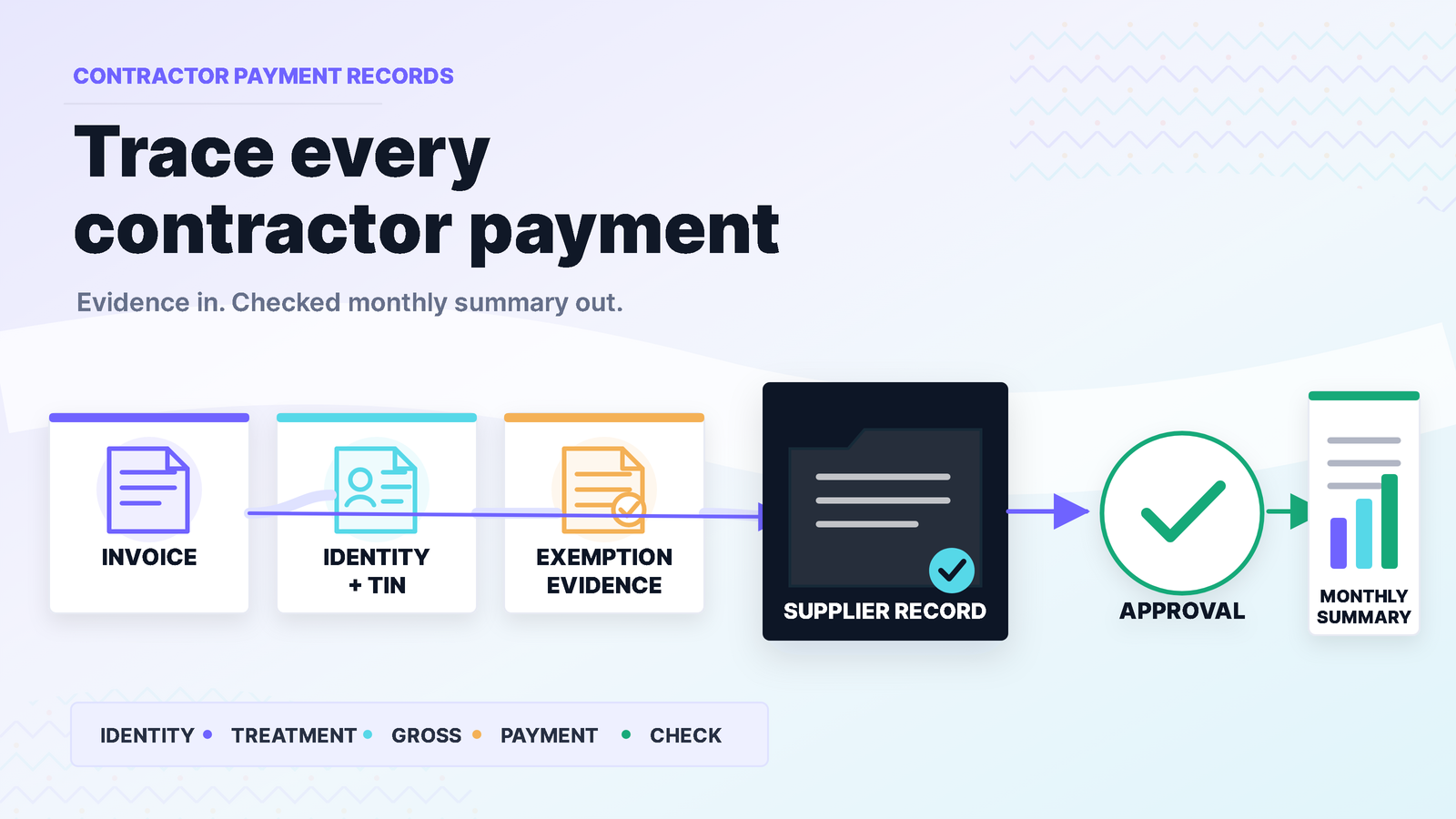
Paying a contractor can look straightforward: approve the invoice, make the payment and file the document. The monthly reporting behind that payment is where gaps tend to surface.
A contractor may trade under one name but invoice under another. A Certificate of Exemption may have expired. The invoice may be in the accounting system while the contractor's TIN sits in an email. A bank payment may combine two invoices. Someone may know why no provisional tax was deducted, but that explanation never reaches the person preparing the monthly summary.
Those small breaks matter because Fiji's 2026-2027 Budget Bills propose a broader reporting trail.
Income Tax (Budget Amendment) (No. 2) Bill 2026 proposes that a monthly Provisional Tax summary include all contractors engaged by a person, whether or not provisional tax was withheld. The proposal also covers contractors with a valid Certificate of Exemption and calls for the gross payment made to each contractor to be included. A related Tax Administration Bill proposes a daily penalty where required contractor information is omitted from a monthly summary.
As at 22 July 2026, TAS has not found a final Act or updated FRCS implementation notice for these changes in the official public material reviewed. The Bills propose commencement from 1 August 2026 if enacted. Businesses should confirm the final law, form fields, effective date and filing procedure with FRCS or their tax adviser.
The sensible operational response is not to guess what the final return will look like. It is to make sure the contractor record can support it.
Start with one contractor register
Create a single register for every contractor the business engages. Do not limit it to contractors from whom tax was withheld.
For each contractor, record:
- legal or registered name;
- trading name, if different;
- TIN;
- contact details;
- type of service;
- contract or engagement reference;
- engagement start and end dates;
- Certificate of Exemption number, issue date and expiry date where applicable;
- the person who checked the details; and
- the date of the last review.
The register should point to the supporting documents rather than becoming a second filing cabinet. A clean link to the contract, TIN evidence and current exemption certificate is more useful than an uncontrolled spreadsheet full of attachments.
Assign one owner. If everyone can update the register but nobody is responsible for it, errors will survive until month-end.
Check the status before the first payment—and again before expiry
FRCS's current public guidance says the payer is responsible for withholding provisional tax when the conditions apply. It also explains that a valid Certificate of Exemption allows the contractor to receive the gross contractual payment without provisional tax being deducted.
That makes status checking part of accounts payable, not an annual clean-up exercise.
Before the first payment, confirm:
- who the business is actually engaging;
- whether the arrangement is a contract for services;
- whether the payment is expected to cross the relevant threshold under current FRCS guidance;
- whether a Certificate of Exemption has been supplied and remains valid; and
- what evidence supports the treatment applied.
Add an expiry alert for every exemption certificate. A PDF saved once is not proof that the exemption remained valid for every later payment.
TAS does not determine whether a worker is an employee or an independent contractor, or whether withholding applies to a specific engagement. Those questions should be confirmed with FRCS or a qualified adviser. The system's job is to preserve the decision and apply it consistently after it has been made.
Keep gross, withheld and net amounts separate
The gross payment is not the same as the amount that clears the bank.
For each contractor invoice or payment, retain fields for:
- invoice date and number;
- service period or job reference;
- gross amount;
- provisional tax withheld, if any;
- net amount paid;
- payment date and bank reference;
- accounting account, job, branch or department; and
- exemption or treatment reference.
This separation becomes especially important when one bank payment covers several invoices, when credits are applied, or when part of an invoice is disputed. The business should be able to move from the monthly total back to the individual invoices and from each invoice to the bank payment.
A description such as "contractor expense" is rarely enough. Use consistent supplier records and meaningful account or job coding so that the monthly review does not depend on memory.
Do not hide exempt contractors outside the normal workflow
Businesses sometimes create an informal shortcut for contractors who hold an exemption certificate: pay the full invoice and leave them out of the provisional-tax workpapers because nothing was withheld.
The proposed change is a clear reason to stop doing that.
Exempt contractors should still pass through the same contractor register, invoice approval and monthly reconciliation. Their exemption status changes the treatment; it should not remove the transaction from the audit trail.
Use a simple exception report each month showing:
- contractors paid with no provisional tax withheld;
- the reason for each treatment;
- exemption certificates nearing expiry;
- missing TINs or duplicate supplier records;
- payments without an invoice or contract reference; and
- manual journals posted to contractor expense accounts.
The purpose is not to assume every exception is wrong. It is to make the reason visible before filing.
Reconcile four totals before the monthly summary
A useful month-end contractor check brings together four views:
- contractor invoices recorded in the accounting system;
- gross contractor payments made through the bank;
- provisional tax withheld and payable; and
- the contractor lines prepared for the monthly summary.
Investigate differences before the return is submitted. Common causes include payments dated in a different month from the invoice, duplicate supplier cards, credits, cancelled payments, manual journals and a contractor mistakenly set up as an ordinary trade supplier.
If the accounting system cannot produce the report in one click, build a repeatable export and reconciliation process. Do not rebuild the population from emails every month.
Give each person a clear role
Contractor reporting usually crosses several desks. Operations engages the contractor. A manager approves the work. Accounts payable enters the invoice. Finance checks the tax treatment. Someone else may file the return.
Write down who must do what:
- Engaging manager: obtains the contract and identity details before work begins.
- Accounts payable: uses the approved contractor record and captures invoice-level fields.
- Finance reviewer: checks exemption evidence, gross payments and withholding treatment.
- Authorised filer: reconciles the monthly summary and retains filing confirmation.
- Owner or manager: reviews unresolved exceptions and repeated failures.
This is a short procedure, not a policy manual. One page is enough if it names the hand-offs and deadlines.
A 30-day preparation plan
Week one: extract every supplier paid for services during the past 12 months. Identify which are contractors and which records need professional review.
Week two: collect missing TIN, contract and exemption evidence. Merge duplicate supplier records carefully and preserve the transaction history.
Week three: configure the required fields, expiry reminders and monthly contractor report in the accounting workflow.
Week four: run a dry reconciliation for the latest completed month. Ask a person who did not prepare it to trace three lines from summary to invoice, approval and bank payment.
This exercise will not decide the final law. It will show whether the business can produce a reliable contractor population when required.
Better reporting starts when the contractor is engaged
Month-end problems are often created before the first invoice arrives. If the person engaging the contractor can start work without supplying the correct identity, contract and tax-treatment evidence, finance inherits a gap it may not be able to fix quickly.
The proposed reporting change raises the stakes, but the business benefit is broader. A reliable contractor register improves expense analysis, job costing, cash planning, approval control and visibility over expiring agreements.
TAS can help Fiji businesses structure MYOB-connected supplier records, contractor-payment workflows, reports and administrator training. TAS does not provide a tax ruling or file a return on the business's behalf unless separately agreed and appropriately scoped.
Sources
- Parliament of Fiji, Income Tax (Budget Amendment) (No. 2) Bill 2026, Bill No. 15, June 2026.
- Parliament of Fiji, Tax Administration (Budget Amendment) Bill 2026, Bill No. 14, June 2026.
- Fiji Ministry of Finance, 2026-2027 Budget Supplement, June 2026.
- Fiji Revenue and Customs Service, Provisional Tax—Contract for Service, accessed 22 July 2026.