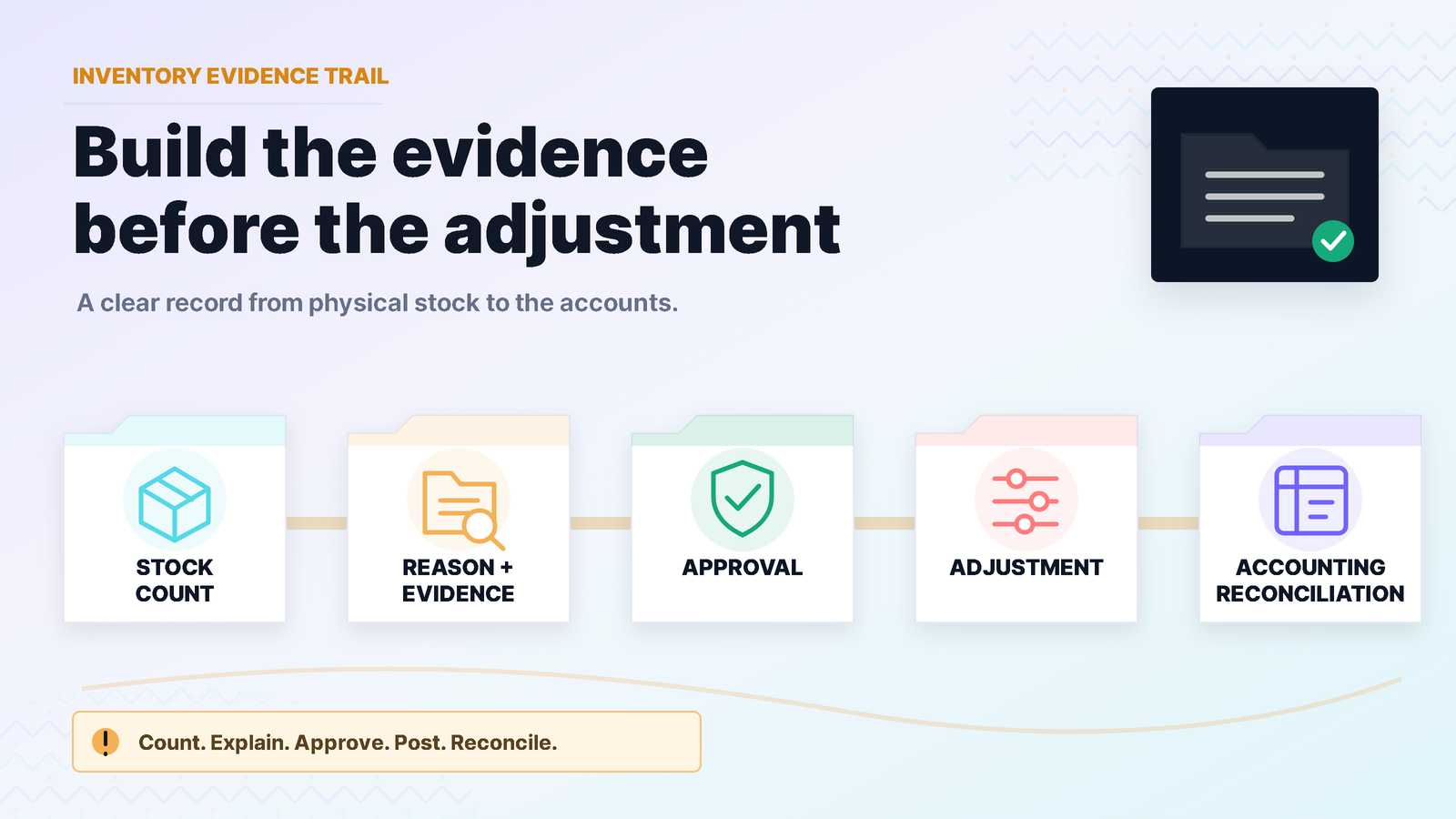
“Write it off” can sound like the final, simple step in an inventory problem. In practice, it should be the end of a trail that begins much earlier.
What stock was affected? Why could it no longer be sold or used? When was the issue identified? Was the quantity checked? Who approved the decision? What happened to the goods? Did the stock system and general ledger move together?
Those questions are becoming more timely for Fiji businesses.
The 2026-2027 Budget Supplement says inventory or asset write-offs exceeding FJ$250,000 will require prior approval from the FRCS CEO. It also says accounts and records provisions will be amended so that taxpayers maintain information in a manner that enables the CEO to readily ascertain tax liability. Parliamentary Bills have been published for the underlying changes, with proposed commencement from 1 August 2026.
As at 22 July, those sources remain proposed measures rather than a basis for TAS to give a legal determination. Businesses should confirm the final Acts, effective dates and FRCS guidance with FRCS or their tax adviser.
But there is no reason to wait before improving the operational record. A good inventory trail is valuable whether a write-off is FJ$2,500 or FJ$250,000.
A write-off is not one type of event
Start by separating the reasons stock leaves the books. Common examples include:
- physical damage;
- expiry or contamination;
- obsolescence;
- theft or unexplained loss;
- stock-count variance;
- quality failure;
- destruction or disposal;
- supplier or freight damage;
- samples or internal use; and
- an earlier receiving, unit-of-measure or data-entry error.
These events do not all require the same response. A counting error should not be documented as damaged stock. Goods returned to a supplier should not disappear through a write-off. A unit conversion error may need a corrected receipt or item setup rather than an expense.
Use clear reason codes, then require a short explanation and supporting evidence appropriate to the event.
1. Freeze the facts before adjusting the quantity
Once staff identify a material stock issue, capture the position before changing the system.
Record:
- item code and description;
- warehouse, branch or bin;
- system quantity;
- physical quantity counted;
- unit and extended value;
- batch, serial or expiry details where relevant;
- date and time identified;
- person who counted and person who checked; and
- photographs or other evidence where appropriate and permitted.
This is particularly important when the goods will be destroyed, returned or removed quickly. After disposal, the business may no longer be able to reconstruct the evidence.
2. Investigate the cause before approving the accounting result
An adjustment makes the stock balance agree. It does not explain why the difference occurred.
Before approval, check the recent transaction trail:
- purchase receipt and supplier documents;
- transfers between locations;
- sales, returns and credits;
- production or assembly movements;
- manual adjustments;
- unit-of-measure changes;
- negative-stock activity; and
- user and timestamp history.
The goal is not to turn every small variance into a long investigation. It is to avoid writing off stock when the real issue is an unposted transfer, duplicate receipt, wrong item code or incomplete return.
If the same reason keeps appearing, treat it as a process problem. Repeated “count variances” may point to weak receiving, uncontrolled transfers or sales leaving the premises before they are recorded.
3. Separate counting, approval and posting
One person should not be able to identify a loss, approve it and post the final adjustment without review.
For smaller businesses, perfect separation may not be practical. A workable control is still possible:
- one person prepares the count and explanation;
- an owner, manager or finance reviewer checks the evidence;
- an authorised user posts the approved adjustment; and
- the posting appears on a regular exception report.
Set approval levels by value, reason and risk. A high-value or unusual adjustment should receive more scrutiny than routine, documented wastage within an approved operating policy.
4. Keep value as carefully as quantity
The quantity may be obvious while the value is not.
Imported and stock-heavy businesses often carry freight, duty and other landed costs in addition to supplier price. Different costing methods, foreign-currency movements and partial receipts can also affect the value attached to the quantity being removed.
The person approving the write-off should understand how the system calculated the value and which account will receive it. A round-dollar journal prepared outside the inventory system can leave quantity and value out of step.
TAS's MYOB inventory and landed-cost guide explains why purchasing, freight, duty, stock quantity and accounting value need to be considered together.
5. Reconcile the inventory record to the general ledger
After posting, prove that the adjustment reached every place it was meant to reach—and nowhere else.
Check:
- item quantity and value after adjustment;
- inventory valuation report;
- adjustment or write-off expense account;
- tax treatment where applicable and professionally confirmed;
- branch, department or job allocation;
- general-ledger inventory control account; and
- any management report used to review shrinkage or gross margin.
If the inventory valuation and control account do not agree before the write-off, record that separately. Do not hide an old reconciliation difference inside a new adjustment.
6. Build an evidence pack that someone else can follow
For each material write-off, keep one indexed pack or digital record containing:
- adjustment request;
- count sheet or item listing;
- reason and investigation notes;
- supporting documents or images;
- valuation method and report;
- approval record;
- system transaction reference;
- disposal, destruction, return or other outcome evidence; and
- post-adjustment reconciliation.
Use consistent names and sequence the documents. A folder full of unrelated files is not the same as a clear record.
This matters because the Budget's record-keeping proposal is not simply about possessing documents. It focuses on maintaining records in a way that lets the tax position be readily ascertained.
7. Watch the pattern, not only the largest adjustment
A single large write-off will attract attention. A series of small write-offs can be just as important operationally.
Review adjustments by:
- item and category;
- branch or warehouse;
- reason code;
- user;
- supplier;
- month; and
- value as a percentage of sales or stock held.
Look for repeat items, repeat locations and adjustments posted just before stocktake or month-end. The purpose is not to assume wrongdoing. It is to find where process, training, security or item setup needs attention.
For businesses connecting counter sales with stock and accounts, the accounting and POS software guide provides a useful view of the wider transaction path.
8. Prepare early if a write-off may approach the proposed threshold
If a contemplated inventory or asset write-off could exceed FJ$250,000, do not wait until the goods have been removed and the accounts are closing.
Confirm the final law and current FRCS process first. Then establish:
- whether prior approval is required for the specific transaction;
- how the amount is measured;
- what form and evidence FRCS requires;
- whether separate events can or cannot be considered together;
- how damaged or unsafe goods should be handled while approval is pending; and
- who is authorised to communicate with FRCS.
These are questions for FRCS and the business's tax adviser. TAS can help make sure the underlying stock and accounting records are organised, but it cannot grant approval or determine tax treatment.
A monthly control that takes less than an hour
Each month, ask finance and operations to review four things together:
- the ten largest inventory adjustments;
- adjustments with missing or vague reasons;
- repeat items or locations; and
- the inventory-to-ledger reconciliation.
Agree one owner and due date for each unresolved item. This modest routine often reveals issues earlier than the annual stocktake, when the original transaction is much harder to trace.
Strong records make better decisions before they satisfy a rule
The proposed law changes raise the importance of evidence, but compliance is not the only reason to improve inventory controls.
Clear adjustment records protect margin analysis, purchasing decisions, insurance claims, responsibility between locations and confidence in the accounts. They help management see whether the business has damaged stock, obsolete stock or simply unreliable transactions—three very different problems.
TAS works with Fiji businesses on MYOB-connected inventory, landed-cost workflows, SalesRight, POS, reporting, training and support. The first step is to understand how stock enters, moves, sells and leaves the books.
Sources
- Fiji Ministry of Finance, 2026-2027 Budget Supplement, June 2026.
- Parliament of Fiji, Income Tax (Budget Amendment) (No. 2) Bill 2026, Bill No. 15, June 2026.
- Parliament of Fiji, Tax Administration (Budget Amendment) Bill 2026, Bill No. 14, June 2026.