Payroll changes rarely fail with a dramatic warning. More often, the first sign is a payslip that looks slightly wrong, a contribution report that no longer agrees, or an employee asking why this fortnight is different from the last one.
That is why the announced FNPF change deserves preparation, even while employers wait for final operational confirmation.
The Fiji Government's 2026-2027 Budget says the mandatory employer contribution rate will reduce from 10% to 8% for the period from 1 August 2026 to 31 July 2027. The employee contribution rate is announced to remain at 8%. A corresponding Bill has been published by Parliament, but as at 22 July the FNPF employer page still describes the current combined compulsory contribution as 18%: 8% from the employee and 10% from the employer.
That distinction matters. A Budget announcement and a Bill are strong reasons to get ready; they are not reasons to quietly change a live pay run before the effective requirements are confirmed.
Here is the practical work employers can do now.
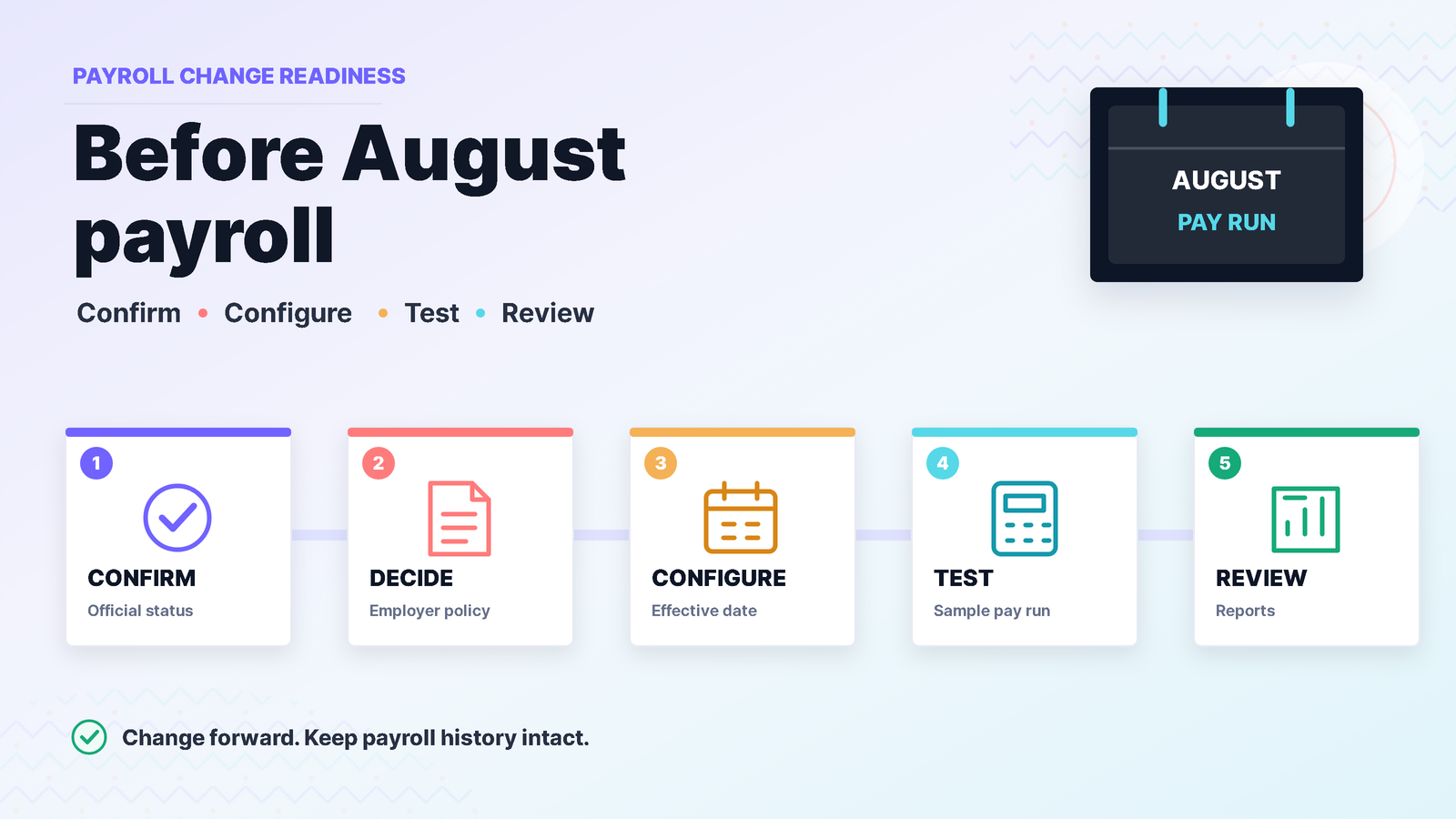
1. Confirm the rule before touching the rate
Give one person responsibility for checking the final position through an official FNPF, Parliamentary or government source. Record the source, the date it was checked and the effective date that applies.
Your confirmation should answer four questions:
- Has the amendment been enacted?
- Has FNPF issued employer guidance for the change?
- Which pay periods and contribution months are affected?
- Are there any filing, portal or reporting instructions that change with the rate?
Do not rely on a screenshot passed around in a messaging group or an old payroll note saved on someone's desktop. Payroll needs one dated instruction that the person preparing the pay and the person reviewing it can both follow.
2. Decide what the business intends to contribute
The announced mandatory employer rate is 8%, but that does not automatically answer every employer's policy question.
Some businesses may choose to contribute only the mandatory amount. Others may already have employment agreements, workplace policies or additional-contribution arrangements that need to be reviewed. The Budget also announces a tax incentive for employer contributions above the proposed mandatory 8% and up to 10%, but eligibility and tax treatment should be confirmed with FRCS or a qualified adviser before a business relies on it.
Make the policy decision first. Then configure payroll to reflect that decision. Software should not be asked to settle an employment, tax or remuneration question that management has not answered.
3. Add an effective-dated change; do not rewrite history
A new rate should apply from the correct date forward. It should not alter prior pay runs, historical reports or contribution records.
Before making the change, check how your payroll system handles effective dates. If the system stores only a single current rate, document the old setting and take the appropriate backup or payroll archive before updating it. If it supports dated rules, confirm that the new rule begins in the correct contribution period.
This is especially important where a pay period crosses 1 August. Do not guess how the period should be treated. Confirm the applicable FNPF guidance and your payroll system's calculation method.
For a broader review of pay-run setup and accounting hand-offs, see TAS's payroll software and MYOB workflow guide.
4. Run a controlled test before the first affected payroll
Choose a small set of test employees that reflects the situations your payroll actually handles. Include, where relevant:
- a straightforward salaried employee;
- an hourly employee with variable time;
- an employee with overtime or allowances;
- someone with an additional employer contribution; and
- an employee whose pay changes during the test period.
For each case, calculate the expected employee contribution, employer contribution and net pay independently. Then compare those figures with the payroll result.
The point is not to test every employee manually. It is to prove that the rate, wage base, rounding, effective date and reporting all behave as expected before the live run.
5. Check more than the payslip
A correct-looking net pay does not prove that the complete payroll is correct.
Review the outputs that sit around it:
- payroll summary;
- employee and employer contribution totals;
- FNPF contribution report or submission file;
- payroll liability accounts;
- general-ledger posting or MYOB journal;
- cost-centre or department reports; and
- any management report that uses total employment cost.
The announced reduction affects the employer's cost, even if the employee deduction remains unchanged. Budgets, job costing and management reports may therefore need attention as well as the pay calculation itself.
6. Keep one reviewer outside the setup
The person who changes the rate should not be the only person who checks the result.
A useful review is short and specific. Ask the reviewer to confirm:
- the official rate and effective date used;
- the old rate remains on historical periods;
- employee deductions have not changed unexpectedly;
- employer contributions agree with the approved policy;
- totals post to the intended liability and expense accounts; and
- the contribution report agrees with the payroll summary.
That six-point check is far more valuable than a general instruction to “have a look at payroll”.
7. Tell employees what is changing—and what is not
If the final rules follow the Budget announcement, the employee contribution rate remains at 8%. Employees may nevertheless notice a different employer contribution on their payslip or hear incomplete explanations elsewhere.
Prepare a short, factual message based on official guidance. Avoid turning it into financial advice. Explain the effective period, what the business is changing and whom employees should ask if their personal record appears incorrect.
Clear communication reduces payroll queries and gives employees a chance to identify genuine anomalies promptly.
8. Prepare a fallback for the first August run
Do not schedule the first affected payroll so tightly that there is no time to correct it.
Before processing, know:
- who can approve a configuration correction;
- how to restore the prior setup if the effective date is wrong;
- whether a corrected submission file can be regenerated;
- who will contact FNPF if official guidance is unclear; and
- how the decision and final test evidence will be retained.
This is not over-engineering. It is a small amount of preparation around a payment process that affects every employee.
A useful one-page payroll change record
Keep a simple change record with the payroll file:
- official source and access date;
- approved employer policy;
- old and new settings;
- effective date;
- test cases and expected results;
- reviewer's name and approval date;
- first live pay run affected; and
- any follow-up item after submission.
Six months later, this page will answer questions faster than a trail of emails and screenshots.
Get ready now, change only when confirmed
The sensible approach is neither to ignore the announcement nor to rush a change into production. Confirm the rule, make the employer decision, test the payroll and retain the evidence.
TAS supports Fiji businesses with payroll setup, accounting-connected workflows, implementation, training and practical support. We can help review the software and process side; employers should confirm statutory, employment and tax obligations with FNPF, FRCS or their professional adviser.
Sources
- Fiji Ministry of Finance, 2026-2027 Budget Supplement, June 2026.
- Parliament of Fiji, Fiji National Provident Fund (Budget Amendment) Bill 2026, Bill No. 22, June 2026.
- Fiji National Provident Fund, Employers, accessed 22 July 2026.