Training often begins with a course catalogue. It should begin with the work.
Where does the sales process break down? Which payroll checks depend on one experienced person? Who can correct an item setup without making the stock report worse? Can a new employee follow the month-end process without borrowing someone else's login? If the person who normally completes a task is away, does the process stop?
Those questions are timely for Fiji employers.
The 2026-2027 Budget Address says that, effective from 1 January 2027, half of the existing one percent levy will be redirected towards training and skills development, with another ten percent allocated for public-sector training and forty percent continuing to support workers compensation. The Budget Supplement describes the Training Grant Scheme allocation increasing from 0.1 percent to 0.5 percent.
The Budget Address also announces a 200 percent tax deduction for eligible employer training and upskilling expenditure. Separately, the Budget Supplement lists a 150 percent investment allowance for businesses that establish training centres, institutes or technical centres.
Those are different measures. They should not be combined, and they should not be treated as presently claimable without checking the final legislation and current FNU, NTPC and FRCS guidance. FNU's public Levy and Grants page, accessed on 22 July, still describes the existing allocation and grant framework.
The policy direction is clear enough: workforce capability is receiving more attention. The practical question is whether a business can turn training into better work.
Map the workflows before choosing the courses
List the workflows that keep the business moving. For a typical owner-managed or growing Fiji business, these may include:
- quoting and customer setup;
- sales invoicing and receipting;
- cash, card and e-wallet reconciliation;
- purchasing and supplier payments;
- receiving, transfers and stock counts;
- payroll setup, processing and checking;
- VMS or fiscal invoice procedures where applicable;
- month-end accounting and reporting;
- user administration and access control; and
- backup, escalation and support requests.
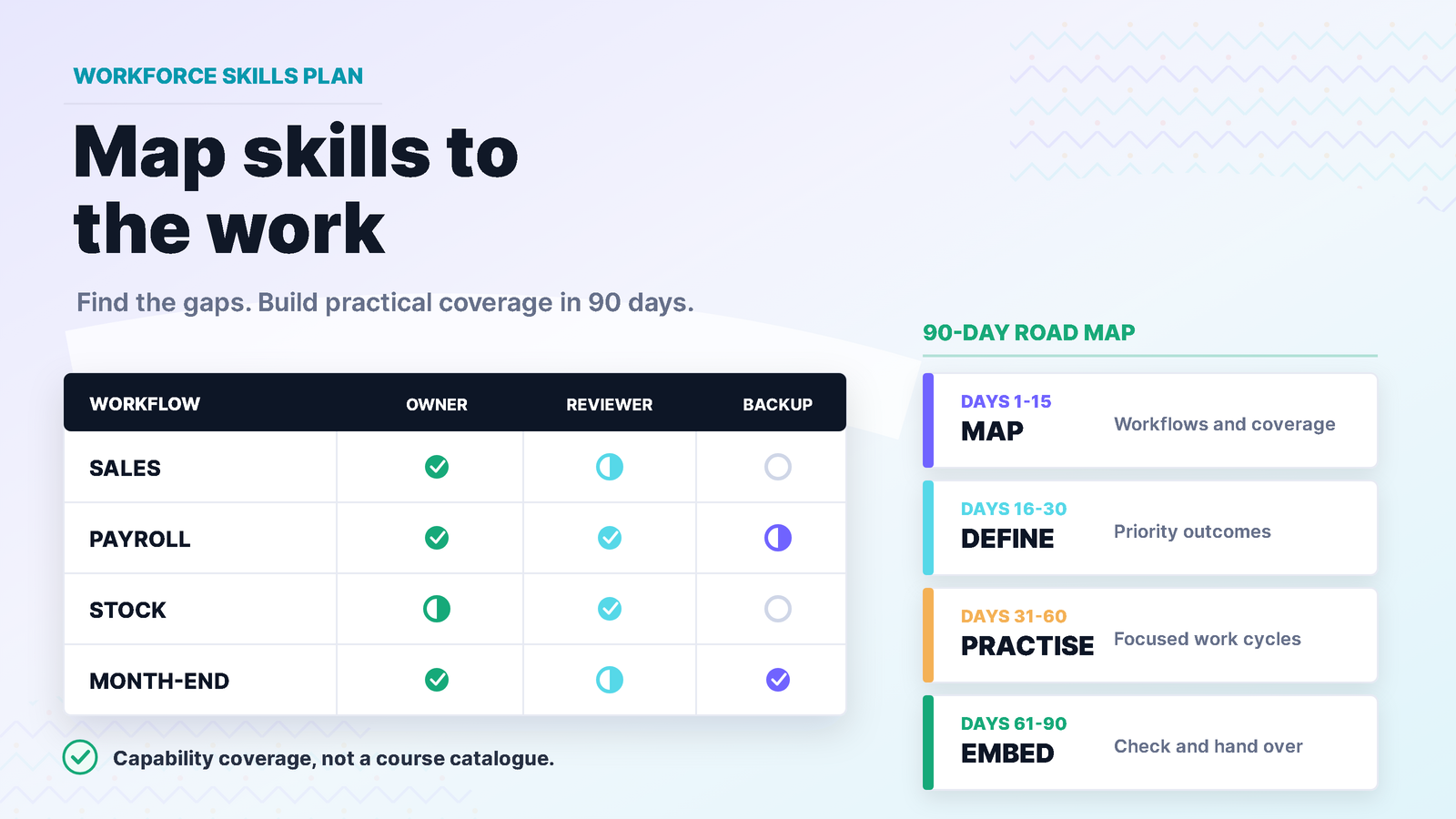
For each workflow, name the person who performs it, the person who can check it and the person who can cover it. Blank spaces reveal the training need more honestly than a general request for "advanced software training."
Separate knowledge gaps from process problems
Not every recurring error calls for another class.
If staff have never been shown how to apply a credit correctly, training may solve the problem. If three departments use different approval rules, the process needs to be agreed first. If employees share logins, access must be corrected. If item codes and tax settings are wrong, the system needs clean-up before users are trained on it.
Use three labels:
- Teach: the process is sound, but the person needs knowledge or practice.
- Fix: the workflow, setup or responsibility is unclear.
- Control: the task is understood, but review, permission or evidence is weak.
This prevents a common waste: sending people to training and returning them to the same broken workflow.
Build a simple role-versus-skill matrix
Keep the matrix practical. Score each person against the tasks they actually perform:
- 0 — Not required: outside the role.
- 1 — Needs guided support: can assist but not complete the task alone.
- 2 — Can perform: completes the normal process using the procedure.
- 3 — Can check and resolve: reviews exceptions and supports others.
A sales user may need level 2 in customer setup and invoicing, but only level 1 in end-of-day reconciliation. A payroll backup may need level 2 in a normal pay run and level 1 in complex adjustments. The finance lead may need level 3 in month-end review but no role in warehouse transfers.
Avoid inflating scores. The matrix is not a performance ranking; it is a coverage map.
Prioritise the gaps that can interrupt business
Not all gaps carry the same risk. Give priority to a skill when:
- only one person can perform the task;
- errors affect customers, employees, cash or statutory records;
- the task happens under a tight deadline;
- the volume is growing;
- the process has changed; or
- the team repeatedly needs emergency support.
This usually moves payroll, invoicing, reconciliation, inventory adjustments and user access above optional reporting features.
Choose three to five priority outcomes for the next 90 days. "Learn MYOB" is too broad. "Two staff can complete and independently check the weekly bank reconciliation" is measurable.
Design training around real work
The strongest session uses the business's workflow, safely prepared examples and the correct roles.
Before training, confirm:
- the software edition and relevant modules;
- the task each attendee must perform;
- whether configuration changes are needed first;
- the sample data that can be used without exposing customer or employee information;
- the procedure attendees will take away; and
- the practical check that will show competence.
One long session is rarely the answer. A better pattern is short instruction, supervised practice, live use and a follow-up review of exceptions.
TAS Academy can support product and workflow training, but training scope should be confirmed before a booking. A TAS training session or completion record is not the same as FNU or NTPC grant eligibility, professional accreditation or regulator approval.
Keep evidence that explains the business purpose
Even without relying on a future incentive, good training records help management see what it paid for and what changed.
Keep:
- the identified workflow gap;
- approved training objective;
- provider and course details;
- attendee names and roles;
- dates, duration and delivery method;
- invoice and proof of payment;
- attendance or completion evidence;
- materials or procedure issued; and
- follow-up result.
If the business later considers a grant or tax claim, confirm the specific evidence and eligibility rules then. Do not assume that useful training is automatically claimable, or that a training provider's own certificate establishes eligibility.
Measure whether the work improved
Thirty days after training, check the task—not whether attendees enjoyed the session.
Useful measures include:
- fewer transactions returned for correction;
- fewer unreconciled items at month-end;
- shorter time to complete a pay run or stock count;
- fewer support calls for the same issue;
- a second person able to cover the task;
- fewer shared-login or permission breaches; and
- procedures updated after real exceptions were found.
If the measure does not improve, ask why. The employee may need more practice, but the system setup, workload or manager approval may be the real constraint.
A 90-day workforce skills plan
Days 1-15: map. List the important workflows, owners, reviewers and backups. Mark single-person dependencies and repeat errors.
Days 16-30: define. Choose the priority outcomes, correct broken procedures and confirm the training format.
Days 31-60: teach and practise. Deliver focused sessions, use safe examples and supervise the first live cycles.
Days 61-90: check and embed. Review results, confirm backup coverage, update procedures and schedule the next skill gap.
This is deliberately small. A plan that changes three critical workflows is more valuable than a long training calendar nobody can connect to daily work.
Training should leave the business less dependent
Good training does more than help one person click through a screen. It makes responsibilities clearer, gives the business a usable procedure and leaves someone else able to check or cover the work.
The Budget's proposed direction creates a useful moment to review workforce capability. The business does not need to wait for 2027 to identify where weak software skills are creating delays, errors or over-reliance on one employee.
TAS works with Fiji businesses on MYOB, VMS for MYOB, SalesRight, POS, payroll, inventory and accounting-connected workflows. Training can be scoped around the system and the work the team must perform.
Sources
- Fiji Ministry of Finance, 2026-2027 Budget Address, paragraphs 220-221, June 2026.
- Fiji Ministry of Finance, 2026-2027 Budget Supplement, sections 1.31-1.33 and tax-policy summary, June 2026.
- Fiji National University, Levy and Grants, accessed 22 July 2026.